There is a particular look that crosses someone's face when I arrive at their door.
Not grief, exactly — though grief is often there too. Something closer to apprehension. A kind of held breath. They've agreed to this, they've invited me in, and yet standing at the threshold they suddenly wonder: what will we find when we start to look? What will they say? What might surface? What will it feel like to slow down, sit still, and go back through it all?
One of my roles as a funeral celebrant is to visit the families of those who have died and help them find the words. We sit together, often in a living room that feels quieter than usual, and we begin to read a life.
What almost always happens — and I have never quite stopped being moved by this — is that within an hour, something in the room shifts. The apprehension softens. People begin to remember things they hadn't thought about in years. Someone laughs unexpectedly. Someone else reaches for a hand. And there is, almost without exception, a sense of relief. Not because the grief has lifted, but because they are looking — really looking — at the whole of a person's story. And the whole of it, it turns out, is something worth seeing.
— — —
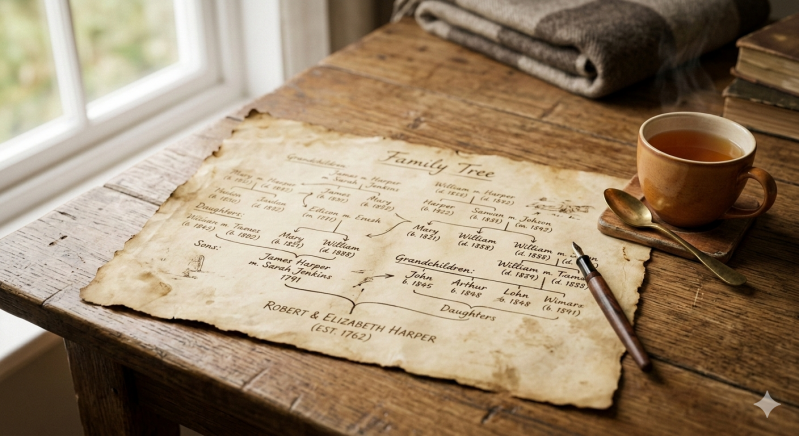
We begin, usually, with a family tree.
The branches spread across the paper — names, dates, the structure of a life before the life itself begins. And then we move through time. Childhood. School. The first job, the early relationships, the moments of ambition and adventure. Work. Family. Hobbies and passions. The places they lived. The people they loved. The things they built and the things they lost.
But here is what I've noticed, across every service I've prepared, from the largest gatherings to the smallest, most intimate rooms: it always comes back to the same thing.
It always comes back to the relationships.
Not the achievements, though those matter. Not the career, though it shaped so much. Not the possessions or the status or the things that filled so many waking hours. When a family tries to tell you who someone truly was, they reach — every time — for the stories of connection. The memories of moments shared. The love given and received. The ordinary Tuesday evenings that turned out to be the whole point.
— — —
Let me tell you about three people whose books I've had the privilege of reading.
There was a retired professor — a microbiologist who had spent decades teaching, shaping the understanding of hundreds of students. But what his family kept returning to wasn't the lectures or the papers or the career. It was the birds. He had developed, quietly and joyfully over the years, a deep love of birdwatching — and in doing so had drawn others into that world, had shared that knowledge and that wonder with everyone willing to follow him into a field at dawn. Two passions, a lifetime of curiosity, and a trail of people who saw the world differently because of him.
There was a young woman, thirty-two years old. She had more energy than most rooms could contain. Parties were her natural habitat — not because she was reckless, but because she understood instinctively that life is better shared, that joy is something you create deliberately for the people around you. She made sure people had fun. She made sure nobody was standing alone at the edge of the room. Her book was short, far too short, but it was vivid on every page.
And there was a lady who was described to me, in the very first conversation, as stubborn, opinionated, and extremely tight with money. If she'd lent you a pound, she'd call to get it back. She knew her own mind completely, said exactly what she thought, and did not apologise for either. By the time her family had finished telling me about her, the room was full of laughter and tears in equal measure. She was loved — fiercely, specifically, entirely — for being exactly who she was.
Three completely different books. Three distinct lives, different in almost every way.
But at each of their funerals, the same thing was true: there were people there who had loved them. Not a version of them. Not a tidier, more impressive, easier-to-summarise version. Them — the whole complicated, particular, unrepeatable them.
You don't have to be remarkable in a conventional sense. You don't have to have lived a tidy, admirable, easy-to-summarise life. You just have to have been genuinely, recognisably yourself — and there are people who love you for precisely that.
— — —
We have rituals, as a culture, for the beginnings of chapters. A wedding marks the moment two separate stories choose to become one. A naming ceremony stands at the very first page of a life, everything still unwritten, all the chapters ahead. These are the moments we gather to mark, to witness, to celebrate.
But it is only at the end of a life that we tend to read the whole book. Only then do we lay out all the chapters — the early ones, the difficult ones, the ones that surprised everyone including the person living them — and see the shape of things. See what it was really about.
I've been thinking a great deal lately about what it would mean to read your own life the way a family reads a loved one's after they're gone.
Not with grief. Not with the weight of an ending pressing down on everything. But with that same quality of attention. That same honesty. That same eye for the real plot beneath the surface plot.
Because here is something I believe, and the work I do has only deepened this belief: your life is a book. And like any good book, it makes considerably more sense when you actually read it.
Most of us don't. Not really. We live forward through the chapters without pausing to understand what we've already written. We carry old storylines into new situations without examining where they came from. We repeat certain patterns — certain arguments, certain fears, certain ways of holding ourselves back — without ever asking what chapter first introduced them.
And sometimes, if we're honest, we avoid certain chapters altogether. The painful ones. The ones where we made choices we're not proud of, or where something happened to us that we've never fully sat with. We skip ahead, hoping the story will resolve itself without us having to go back.
It doesn't, of course. The unread chapters are still in the book.
— — —
I want to ask you something, and I'd like you to take a moment with it rather than answering too quickly.
Have you ever read your own story the way the people who love you would read it?
Not the version you perform for other people. Not the CV or the highlight reel or the story you tell at dinner parties. The actual book. The one with all the chapters in it — the proud ones and the difficult ones, the chapters you'd rather rewrite and the ones you'd want to read again slowly.
I ask because I've watched families do it for their loved ones, over and over, and the honesty of it is always striking. They don't flatten the person into their worst chapter. They don't define them by the single thing they got wrong, or the years that were hard, or the period when they were lost. They hold the whole book. They remember that a life is made of many chapters, many pages, many kinds of weather — and that none of it cancels out the rest.
You deserve to be read that way too. By yourself, first of all.
— — —
If you're reading this on a Saturday morning, with a little more space than the week usually allows, I'd like to leave you with something to sit with rather than something to do.
Not a task. Not a framework. Just a question to carry gently through the rest of the weekend.
In the busyness of your life right now, are you tending the relationships that matter most to you?
Are the people you love most clear that they're loved? Are there connections you've been meaning to nurture that have quietly drifted because life keeps moving so fast? Is there someone you've been thinking about — a friend, a parent, a sibling, someone from an earlier chapter of your story — that you keep meaning to call?
The world has a clear idea of what a successful chapter looks like. The right job title. The house. The car. The salary that tells the story before you've said a word. And most of us spend a significant portion of our lives writing toward that definition, measuring ourselves against it, wondering if we're keeping up.
But the chapter you're in right now is being written alongside all of that — and it contains something the world's version of success doesn't always account for. Because when it's read later, by you or by the people who love you, the deadlines met and the inbox cleared and the car on the drive won't be what the page is really about. The promotion you worked so hard for, the deal you closed, the house you upgraded — they'll be there, somewhere in the background. But they won't be the story.
It will be this. The connections. The love. The ordinary moments that turned out to be the whole point.
Your book is worth reading. And the people in it are worth reaching for.
— — —
Matt | The Book of You
thebookofyou.co.uk
Add comment
Comments
I found this so true! !
I just want to tell my ex husband how sorry I am for causing him pain and sadness! He died 3 weeks ago and I wasn’t allowed to say goodbye. Looking back - he was the love of my life and I messed up!
Trying to forgive yourself is the hardest!
I have good friends who are being so supportive and I will now thank them!